Rated 1-minute short time power frequency withstand voltage: 42 kV
Lightning impulse withstand voltage: 75 kV
Frequency: 50Hz
Operating Sequence CO-30min-CO
Operating Voltage: 110 V (DC)
Motor Voltage: 110 V (DC)
Type: VTK-12
Carried Standard: GB/T14824
Weight: 175 kg
Manufactured date: December, 2017
Unit 1 Shut Down due to Faulty Breaker: From May 13 12:50 PM to May 15 4:10 PM
VCB Trip Record:
S. N
Generator Unit
Number of Trips of VCB
Remarks
1.
Unit-1
958
Before maintenance
2.
Unit-1
1005
After maintenance
3.
Unit-2
829
Determining the Source of Faulty Operation:
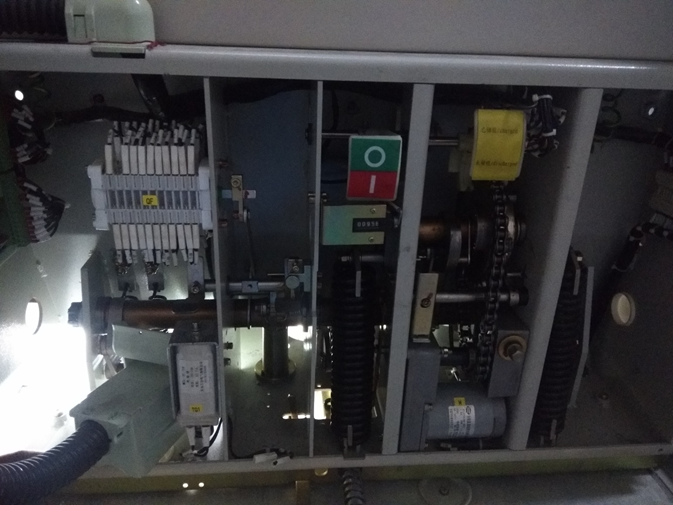
After taking VCB out of the VCB compartment from high voltage cabinet, number of trips of each unit was noted. Number of trips of unit-1 was 958 while number of trips of unit-2 was 829 according to trip counter in three years of operation (from 15th March 2019 to 15th May 2022), which is lower number of trips in comparison to other power plants. Likewise, operation of spring charging motor was monitored and found to be operating normally.
Annex 1: VCB Inspection after Taking out of the VCB compartment
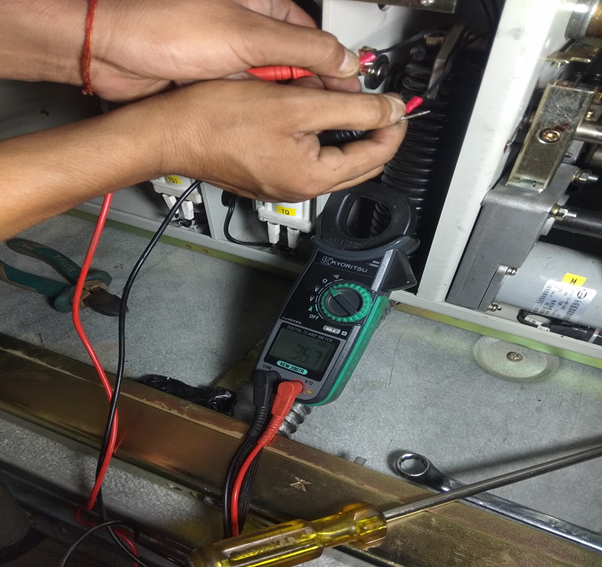
Then condition of the tripping coil and closing coils were tested and there was no damage on these coils. Resistance of trip coil is tested for checking the continuity in order to ensure that it is not in open circuit condition. Measured resistance is 36.7 Ω which is same as rated resistance implying the continuity of circuit.
Annex 2: Checking Continuity of Trip Coil
Possibility of error in operation due to faulty electrical parts were ruled out however moving contacts of the VCB were not driven by operating mechanism. Condition of below mentioned parts were inspected:
LV Plug Connectors
Charging Mechanism Gear Box
Manual Spring Charging Port
Closing Spring
Open and Close Push Button
Auxiliary Driving Components
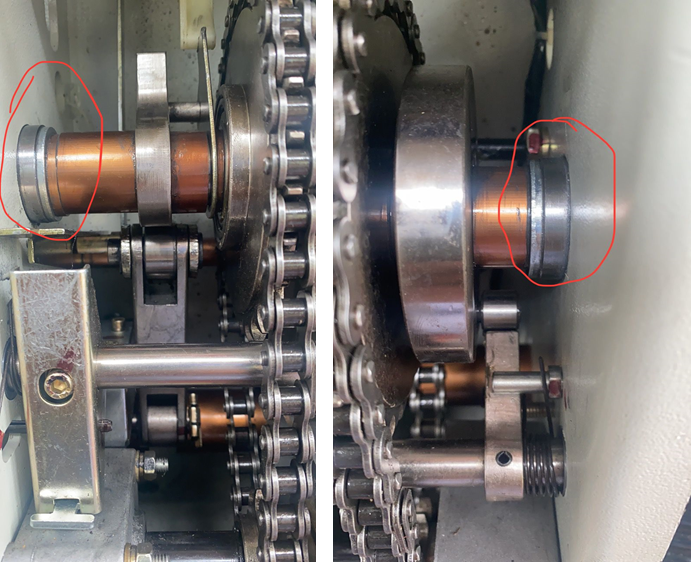
Based on our observation all the above-mentioned parts seem to be in normal condition however the VCB was still not operational. Furthermore, due to lack of documentation on the VCB from manufacturer, it took time to figure out the problem. After careful inspection by manually operating VCB multiple times, source of problem was found to be loose spring near the trip coil and disorientation of the bush that holds the rod on which the chain wheel of the spring charging mechanism is housed.
On identifying the source of problem, the following solution was made for effective functioning of the VCB.
The loose spring near trip coil was firmly hold with the help of the external wire which was tied at nearby nut-bolt (please refer to Annex 3).
The disoriented holding bush – due to vibration of VCB tripping and closing operation, was reoriented by hammering to original position (please refer to Annex 4).
The VCB was properly able to respond to the trip and close command after this temporary solution.
Annex 3: Spring Near Trip Coil Repositioned and Tightened with the External Wire
Annex 4: Reorienting the Holding Bush on Both Side
Conclusion:
The VCB is not supposed to have faulty operation only with 958 trips that too in three-year period. It is situated inside the high voltage cabinet. Furthermore, it is operated remotely either through the SCADA or from the LCU panel. During its period of operation, no manual tripping was done by pushing the open and close push button of the VCB. Therefore, there is no chance of tampering the integrity of the VCB externally during the operation of plant. In this case VCB was not able to close the circuit even once. But we have experienced difficulty of closing the VCB of unit-1 prior to this date too. O&M staff initially thought that this problem may be due to governor PID controller not being able to track the grid frequency and thereby failing to give closing signal to VCB. However, this was not the case. After maintenance of VCB, it has properly responded to the closing command till date. Also, it is to be noted that we are not facing such problem from VCB of unit-2. All in all, it is concluded that the defective VCB is the cause of the interruption in operation of unit-1.
Recommendation:
A spare of VCB is recommended to be kept as stock at power house so that any unit is not required to be stopped during such event.
A permanent solution is recommended for this temporarily solved problem.